Vladimir Lensky–Olga Larina relationship
Eugene OneginVladimir Lensky–Olga Larina relationship is a romance rooted in childhood expectation and undone by jealousy. The narrative first presents the pair beneath the shelter of an oak, where young Lensky plays with Olga while their parents, already friends for life, imagine the children as a future husband and wife. Years later, Lensky is still looking toward marriage, but an episode involving Olga and Eugene Oneguine transforms his confidence into resentment and estrangement. The relationship’s importance lies in this sharp movement from inherited promise to a rupture that feeds the fatal conflict of the novel.
Childhood and the Promise of Marriage
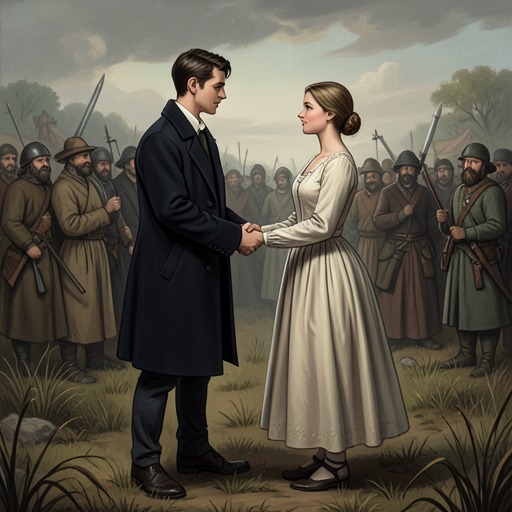
The relationship’s beginnings precede the lovers’ adult understanding of love. As a boy, Lensky sees Olga with tenderness, before he knows the ache of the heart; their shared play beneath an oak belongs to a world of innocence and familial reassurance. The parents’ friendship gives the children’s closeness a social frame: they imagine the pair as future man and wife, making marriage seem less like a distant possibility than the natural continuation of a bond already blessed by the household.
That early picture is consequential precisely because it is not a promise made by Lensky and Olga themselves. It is the adults who dream their future into place. The poem thus sets the romance against a contrast between childhood expectation and adult feeling: a match can be anticipated by family and still remain vulnerable to jealousy, misunderstanding, and the lovers’ unequal responses to events. Lensky’s later conviction that he was made for matrimony echoes the old expectation, but cannot secure its fulfilment.
Lensky’s Expectation of Marriage
At the point when the marriage date is still three weeks away, Lensky is described as especially cheerful. The approaching wedding is not merely a remote prospect: its date is close enough to shape his present happiness, and the poem evokes the secrets of married life as an imminent threshold. This detail makes his later emotional collapse more than a general disappointment in love. He stands on the edge of the future he has anticipated since childhood.
The narrator’s lament that Lensky seemed born for matrimony sharpens the irony. Lensky’s romantic orientation appears deeply settled, yet the plot does not permit the expected marriage to become his adult life. His death is mourned in relation to that thwarted future: the loss includes not only the young man himself but the domestic destiny toward which he seemed to be moving. The childhood image of the oak-shaded play and the near wedding date therefore frame the relationship at opposite ends of its brief arc, from imagined lifelong union to a future cut short.
Jealousy and the Rupture
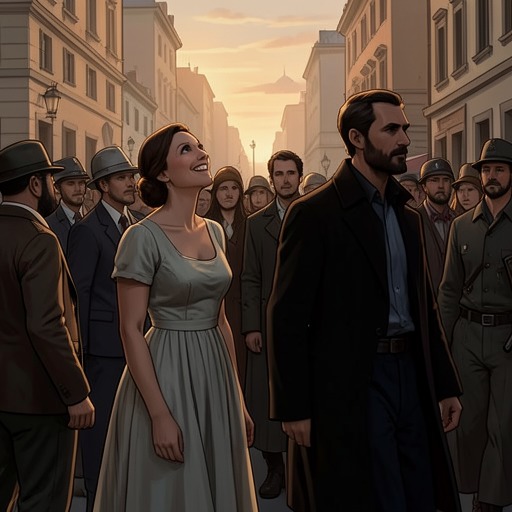
The crisis emerges at Tatyana’s name-day gathering, where Eugene brings Olga and Tatyana to Lensky’s cousin Bouyanoff. The account foregrounds Lensky’s perception of Olga’s response to Eugene: when she is asked whether she fears she cannot accept, the answer is that she promised Eugene she would, and that she would do so with great delight. Whatever the scene’s playful or social context, those words reach Lensky as a blow. His jealousy is intensified by the contrast between his expectation of an approaching marriage and Olga’s apparent readiness to give Eugene her attention.
Lensky cannot sustain the shock. He curses womankind, leaves, and orders his horse out. These are the concrete gestures of a withdrawal: instead of clarifying what Olga’s willingness means, he turns away from the gathering and converts hurt into a sweeping denunciation. The movement from the scene’s social exchange to his departure gives the relationship’s rupture an immediate physical form. The horse carries him away from the woman he expects to marry and toward the chain of actions that will make reconciliation impossible.
Tragic Consequence and Narrative Significance
The relationship is inseparable from Lensky’s fatal trajectory. The narration repeatedly places the prospect of marriage beside the knowledge of his fate: the narrator calls him “My wretched Lenski” and mourns that he seemed born for matrimony. The juxtaposition makes the wedding expectation a measure of what his death destroys. His attachment to Olga is not developed into a shared married life; it remains an anticipated future, first projected by their parents and then cherished by Lensky himself.
Olga’s apparent willingness to please Eugene at the gathering triggers Lensky’s anger, but the episode also exposes the fragility of the childhood story imposed on the couple. Parental confidence could envision them as husband and wife; it could not protect their relationship from the pressures of adult conduct, public sociability, and Lensky’s wounded response. The romance therefore carries a double meaning in the poem: it is a tender promise of ordinary domestic happiness, and, through the abruptness of its collapse, a reminder that an imagined future can be extinguished before it is lived. The oak tree and the almost-arrived wedding date mark the distance between what the families hoped for and what Lensky’s fate allows.